Author: admin

“A book must be the axe for the frozen sea within us.”


Franz Kafka, in 1904:

Altogether, I think we ought to read only books that bite and sting us. If the book we are reading doesn’t shake us awake like a blow to the skull, why bother reading it in the first place? So that it can make us happy, as you put it? Good God, we’d be just as happy if we had no books at all; books that make us happy we could, in a pinch, also write ourselves. What we need are books that hit us like a most painful misfortune, like the death of someone we loved more than we love ourselves, that make us feel as though we had been banished to the woods, far from any human presence, like suicide. A book must be the axe for the frozen sea within us. That is what I believe.

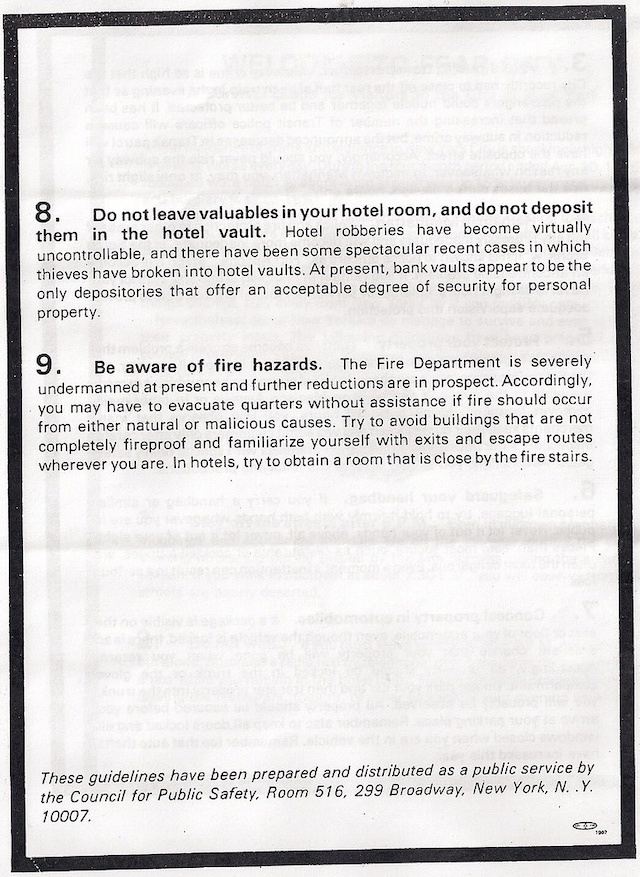
Welcome to Fear City: A Survival Guide for Visitors to the City of New York


Welcome to Fear City: A Survival Guide for Visitors to the City of New York was a pamphlet created by the New York Council for Public Safety in 1975.

Gothamist:

The pamphlet was put together as part of an anti-layoff drive of sorts. In 1975, the NY Times wrote, “For the second time in as many days, unions representing policemen, firemen and other public-safety officers won affirmation in court yesterday of their constitutional right to pass out ‘Fear City’ leaflets at transportation terminals, hotels an shopping districts. The unions, however, faced with mounting criticism of their tactics in attempting to pressure the Beame administration to rescind planned layoffs of 10,962 uniformed officers, continued to hold in abeyance distribution of the black-bordered, skull-emblazoned pamphlets warning tourists to stay out of New York because of rampant crime and inadequate fire protection.”

Barry Popik:

New York City was in dire financial straits and Mayor Abraham Beame had proposed heavy cuts in municipal services. The pamphlet—with a skull on the cover—was aimed to discourage tourists from visiting New York City. The pamphlet had received such negative publicity that it was not distributed, although the unions distributed other pamphlets to get their message out.

Negative nicknames for New York City during this economic crisis period included “Default City,” “Fear City” (by the police and fire unions), “Stink City” (sanitation unions), and “Stupid City” (teachers unions).

“We spend nearly as much on water delivered in small plastic bottles as we do on sustaining the entire water system of the country.”


Charles Fishman, writing in The Big Thirst: The Secret Life and Turbulent Future of Water (2011):

Americans spent $21 billion on bottled water in 2009. It doesn’t seem like an astonishing sum of money – about $65 per person, $1.25 a week. But in the context of water, $21 billion is huge.

Consider, for instance, what Americans spend for all the water delivered to their homes – 350 gallons per family per day, 365 days a year. The water bill comes to about $412 a year. Which means we spend $46 billion a year on all the household water we use all year long – to run the morning shower, to boil the pasta, to water the lawn. As a nation, we spend $46 billion for a year’s water, always on, whenever we need it. And we spend another $21 billion – almost half as much – for bottled water, for an amount of water that wouldn’t get us through eight hours of water use at home on any given day.

But there’s an even more arresting comparison. We spend about $29 billion a year maintaining our entire water system in the United States – the drinking water treatment plants, the pump stations, the pipes in the ground, the wastewater treatment plants. So as a nation, we spend very nearly as much on water delivered in small crushable plastic bottles as we do on sustaining the entire water system of the country.

When we buy a bottle of water, of course, what we’re often buying is the bottle itself, as much as the water. We’re buying the convenience – a bottle at the 7-Eleven isn’t the same product as tap water, any more than a cup of coffee at Starbucks is the same as a cup of coffee from the coffeemaker on your kitchen counter. But we’re also buying the artful story the water companies tell us about the water: where it comes from, how healthy it is, what it says about us. Bottled water, in that sense, is often simply an indulgence. The problem is that it is not a benign indulgence. We’re moving 1 billion bottles of water around a week in ships, trains, and trucks in the United States alone. That’s a weekly convoy equivalent to 37,800 18-wheelers delivering water. (Water weighs 8.33 pounds a gallon. It’s so heavy you can’t fill an 18-wheeler with bottled water – you have to leave empty space.)

Notes: Titan: The Life of John D. Rockefeller, Sr.


Notes from Titan: The Life of John D. Rockefeller, Sr. (1998) by Ron Chernow:

* Rockefeller equated silence with strength: Weak men had loose tongues and blabbed to reporters, while prudent businessmen kept their own counsel. Two of his most cherished maxims were “Success comes from keeping the ears open and the mouth closed” and “A man of words and not of deeds is like a garden full of weeds.”

* Far more than a technocrat, Rockefeller was an inspirational leader who exerted a magnetic power over workers and especially prized executives with social skills. “The ability to deal with people is as purchasable a commodity as sugar or coffee,” he once said, “and I pay more for that ability than for any other under the sun.” Employees were invited to send complaints or suggestions directly to him, and he always took an interest in their affairs.

* At meetings, Rockefeller had a negative capability: The quieter he was, the more forceful his presence seemed, and he played on his mystique as the resident genius immune to petty concerns. As one director recalled, “I have seen board meetings, when excited men shouted profanity and made menacing gestures, but Mr. Rockefeller, maintaining the utmost courtesy, continued to dominate the room.”

* Standard Oil had taught the American public an important but paradoxical lesson: Free markets, if left completely to their own devices, can wind up terribly unfree. Competitive capitalism did not exist in a state of nature but had to be defined or restrained by law. Unfettered markets tended frequently toward monopoly or, at least, toward unhealthy levels of concentration, and government sometimes needed to intervene to ensure the full benefits of competition.

* “Great wealth is a great burden, a great responsibility. It invariably proves to be one of two things—either a great blessing or a great curse.”

* To Rockefeller, the least imaginative use of money was to give it to people outright instead of delving into the causes of human misery. “That has been our guiding principle, to benefit as many people as possible. Instead of giving alms to beggars, if anything can be done to remove the causes which lead to the existence of beggars, then something deeper and broader and more worthwhile will have been accomplished.”

* Rockefeller reviewed every bill that arrived at home and often patrolled the hallways, turning off gaslights. Such habits were not simply reflexive stinginess but were rooted in bedrock beliefs about the value of money.

* “A man’s wealth must be determined by the relation of his desires and expenditures to his income. If he feels rich on ten dollars, and has everything else he desires, he really is rich.”

“Sex robots are going to emulate an increase in the ratio of women to men.”


Diana Fleischman, from 2018:

The men who would have been most likely to have access to multiple women throughout history were men high in status, like kings and men high in dominance, like warlords. Video games and social media already undermine the native psychological mechanisms that make us work towards status — they supply more immediate rewards and take far less effort than anything we work towards out in the real world. Sex robots are only going to make that worse, especially for young men. The game Love Plus, in which the ultimate reward is simply getting to know a virtual girl and attaining her virtual signals of approval has already replaced pursuing dating real women for thousands of men. Imagine if winning a video game was punctuated not with just saving the princess but having sex with her. Imagine if men could have the diversity of sexual experience of Genghis Khan, Muhammad, or John F. Kennedy without actually achieving anything. Sex robots are about to make the virtual world even more alluring.

What does this mean for women? When the sex ratio changes, so too do sexual norms; sex robots are going to emulate an increase in the ratio of women to men. Contrary to a prediction based on the idea that men would wield greater patriarchal control if they were in higher numbers, a larger percentage of women relative to men on University campuses is associated with women who are more likely to have casual sex and less likely to be virgins. When there are more men than women, women are much less likely to have casual sex. The majority sex (in this case men) competes for the minority sex (in this case women) and the minority sex calls the shots. When there is a female majority in the population, women compete for access to mates with casual sex. Whereas a male majority competing for access to scarce women compete with long-term commitment.

Sex robots will emulate a majority women ratio, shifting women to compete for men’s attention by requiring less courtship and commitment in exchange for sex. The long-term ramifications are unclear, especially the way long-term technologies and cultural norms will interact. Perhaps women will discover they have to make the costs of courtship both low and transparent to compete with sex robots. Or, perhaps, new technology could enable women to recombine their genes with one another, making men enamored with sex robots (or men generally) totally redundant.

“Studies show that we consistently overestimate how much people think about us and our failings.”


Arthur C. Brooks, from 2021:

The ironic thing about feeling bad about ourselves because of what people might think of us is that others actually have much fewer opinions about us—positive or negative—than we imagine. Studies show that we consistently overestimate how much people think about us and our failings, leading us to undue inhibition and worse quality of life. Perhaps your followers or neighbors would have a lower opinion of you if they were thinking about you—but they probably aren’t. Next time you feel self-conscious, notice that you are thinking about yourself. You can safely assume that everyone around you is doing more or less the same.

“The ideal citizen of a politically corrupt state, such as the one we now have, is a gullible dolt unable to tell truth from bullshit.”


Charles Simic, from 2012:

Widespread ignorance bordering on idiocy is our new national goal. It’s no use pretending otherwise and telling us, as Thomas Friedman did in the [New York] Times a few days ago, that educated people are the nation’s most valuable resources. Sure, they are, but do we still want them? It doesn’t look to me as if we do. The ideal citizen of a politically corrupt state, such as the one we now have, is a gullible dolt unable to tell truth from bullshit.

An educated, well-informed population, the kind that a functioning democracy requires, would be difficult to lie to, and could not be led by the nose by the various vested interests running amok in this country. Most of our politicians and their political advisers and lobbyists would find themselves unemployed, and so would the gasbags who pass themselves off as our opinion makers. Luckily for them, nothing so catastrophic, even though perfectly well-deserved and widely-welcome, has a remote chance of occurring any time soon. For starters, there’s more money to be made from the ignorant than the enlightened, and deceiving Americans is one of the few growing home industries we still have in this country. A truly educated populace would be bad, both for politicians and for business.

In the past, if someone knew nothing and talked nonsense, no one paid any attention to him. No more. Now such people are courted and flattered by conservative politicians and ideologues as “Real Americans” defending their country against big government and educated liberal elites. The press interviews them and reports their opinions seriously without pointing out the imbecility of what they believe.

“The very meaninglessness of life forces man to create his own meaning.”


Stanley Kubrick on the meaning of life:

The very meaninglessness of life forces man to create his own meaning. Children, of course, begin life with an untarnished sense of wonder, a capacity to experience total joy at something as simple as the greenness of a leaf; but as they grow older, the awareness of death and decay begins to impinge on their consciousness and subtly erode their joie de vivre, their idealism—and their assumption of immortality. As a child matures, he sees death and pain everywhere about him, and begins to lose faith in faith and in the ultimate goodness of man. But if he’s reasonably strong—and lucky—he can emerge from this twilight of the soul into a rebirth of life’s élan. Both because of and in spite of his awareness of the meaninglessness of life, he can forge a fresh sense of purpose and affirmation. He may not recapture the same pure sense of wonder he was born with, but he can shape something far more enduring and sustaining. The most terrifying fact about the universe is not that it is hostile but that it is indifferent; but if we can come to terms with this indifference and accept the challenges of life within the boundaries of death—however mutable man may be able to make them—our existence as a species can have genuine meaning and fulfillment. However vast the darkness, we must supply our own light.

Playboy Interview: Stanley Kubrick (1968)

“The goal of the non-professional should not be to pick winners.”


Warren Buffett, writing in his 2013 letter to Berkshire Hathaway shareholders:

Most investors, of course, have not made the study of business prospects a priority in their lives. If wise, they will conclude that they do not know enough about specific businesses to predict their future earning power.

I have good news for these non-professionals: The typical investor doesn’t need this skill. In aggregate, American business has done wonderfully over time and will continue to do so (though, most assuredly, in unpredictable fits and starts). In the 20th Century, the Dow Jones Industrial index advanced from 66 to 11,497, paying a rising stream of dividends to boot. The 21st Century will witness further gains, almost certain to be substantial. The goal of the non-professional should not be to pick winners – neither he nor his “helpers” can do that – but should rather be to own a cross-section of businesses that in aggregate are bound to do well. A low-cost S&P 500 index fund will achieve this goal.

That’s the “what” of investing for the non-professional. The “when” is also important. The main danger is that the timid or beginning investor will enter the market at a time of extreme exuberance and then become disillusioned when paper losses occur. (Remember the late Barton Biggs’ observation: “A bull market is like sex. It feels best just before it ends.”) The antidote to that kind of mistiming is for an investor to accumulate shares over a long period and never to sell when the news is bad and stocks are well off their highs. Following those rules, the “know-nothing” investor who both diversifies and keeps his costs minimal is virtually certain to get satisfactory results. Indeed, the unsophisticated investor who is realistic about his shortcomings is likely to obtain better long-term results than the knowledgeable professional who is blind to even a single weakness.

“You live like this, sheltered, in a delicate world, and you believe you are living.”


Anaïs Nin, writing in The Diary of Anais Nin, Vol. 1: 1931-1934:

You live like this, sheltered, in a delicate world, and you believe you are living. Then you read a book… or you take a trip… and you discover that you are not living, that you are hibernating. The symptoms of hibernating are easily detectable: first, restlessness. The second symptom (when hibernating becomes dangerous and might degenerate into death): absence of pleasure. That is all. It appears like an innocuous illness. Monotony, boredom, death. Millions live like this (or die like this) without knowing it. They work in offices. They drive a car. They picnic with their families. They raise children. And then some shock treatment takes place, a person, a book, a song, and it awakens them and saves them from death. Some never awaken.

“The problem of political irrationality is the greatest social problem humanity faces.”


Michael Huemer:

The problem of political irrationality is the greatest social problem humanity faces. It is a greater problem than crime, drug addiction, or even world poverty, because it is a problem that prevents us from solving other problems. Before we can solve the problem of poverty, we must first have correct beliefs about poverty, about what causes it, what reduces it, and what the side effects of alternative policies are. If our beliefs about those things are guided by the social group we want to fit into, the self-image we want to maintain, the desire to avoid admitting to having been wrong in the past, and so on, then it would be pure accident if enough of us were to actually form correct beliefs to solve the problem.

Based on the level of disagreement, human beings are highly unreliable at identifying correct political claims. This is extremely unfortunate, since it means that we have little chance of solving social problems and a good chance of creating or exacerbating them. The best explanation lies in the theory of Rational Irrationality: individuals derive psychological rewards from holding certain political beliefs, and since each individual suffers almost none of the harm caused by his own false political beliefs, it often makes sense (it gives him what he wants) to adopt those beliefs regardless of whether they are true or well-supported.

The beliefs that people want to hold are often determined by their self-interest, the social group they want to fit into, the self-image they want to maintain, and the desire to remain coherent with their past beliefs. People can deploy various mechanisms to enable them to adopt and maintain their preferred beliefs, including giving a biased weighting of evidence; focusing their attention and energy on the arguments supporting their favored beliefs; collecting evidence only from sources they already agree with; and relying on subjective, speculative, and anecdotal claims as evidence for political theories.

Why People Are Irrational About Politics (PDF)

Notes: The Rise and Fall of American Growth: The U.S. Standard of Living since the Civil War


Notes from The Rise and Fall of American Growth: The U.S. Standard of Living since the Civil War (2016) by Robert J. Gordon:

* Advertising developed in part as a result of mass production; likewise, it was said that advertising made mass production possible. Firms decided that there was a limit to attracting customers through lower prices, and they tried the alternative strategy of increasing volume by brand-centric advertising. Although advertising began in the late nineteenth century with the development of the first branded products, its true explosion came in the 1920s, when it became increasingly tied to the newly invented radio.

* Electric lights are an example of a technology that had a great burst of innovation early, in this case 1880–1920, and then stood still afterwards. Although the fluorescent bulb had come to dominate lighting in commercial and industrial settings by 1950, virtually nothing changed in home illumination from 1920 until the development of the compact fluorescent bulb after 1990.

* The current system of airport security all over the world represents an overreaction to the September 11, 2001, hijackings. There was only one weakness in the U.S. airline security system on September 11, and this was that the cockpit doors were flimsy. Within days, they were replaced by completely secure doors that nobody could break through. Although the security issue was completely solved within a week, fourteen years later billions of dollars per year of passenger time continues to be wasted in unnecessary additional security precautions. The pre-2001 security system, based on a quick walk through an X-ray machine to check for guns and metal weapons, would be enough.

* If any year can be anointed as the beginning of the Internet revolution, it is 1995. The introduction of Windows 95 was a sensation, creating long lines of eager buyers waiting for hours in front of stores that would sell it before the doors opened on August 24, 1995. This version of Windows represented the transitional moment in the history of the Internet in that Microsoft’s Internet Explorer, a web browser derived from Mosaic, was available as an add-on to Windows 95.

* Virtually every firm making consumer goods (except for basic food and clothing products) had been forced to make something else during World War II, and every one of these producers learned to be more efficient from the process.

* The unrivaled autonomy of the medical profession began to erode after the 1950s. As hospitals became larger and more complex, administrative control fell increasingly into the hands of professional administrators. Patients also began to challenge the authority of the medical profession. While “for the most part, the authority of the doctor was unquestioned” in 1960, with the surgical profession even earning such high praise as being called a “religion of competence,” by the early 1970s patients were demanding greater say in how they were treated. What had always been a tradition of “doctors know best” changed in 1972 when a federal appeals court in Washington, D.C., for the first time established a legal requirement for informed consent. “According to the new standard, the physician had to tell the patient whatever ‘a reasonable person’ would want to know in order to decide whether to accept the treatment.” In 1973, responding to increasing pressure from healthcare consumers, the American Hospital Association came out with a Patients’ Bill of Rights.

* One of the most important improvements in American industrial efficiency was the establishment by Herbert Hoover of the National Bureau of Standards. Its aim was to create a system of uniformly sized parts, down to screws and bolts, aimed at “simplification of practice, elimination of waste, conservation of materials, minimum training of workers, reduction and savings in supply purchasing and unwieldy inventories, defeat of confusion, and speed in production.”

“Stacked up, the Stasi’s complete files reached 125 miles.”


Tina Rosenberg, writing in The Haunted Land: Facing Europe’s Ghosts After Communism (2010):

The Stasi complex on Normannenstrasse in the Lichtenberg district consisted of 41 brown concrete buildings. In addition, the Stasi possessed 1,181 safe houses, 305 vacation homes, 98 sports facilities, and 18,000 apartments for meetings with spies. The Stasi had a budget of 4 billion East German marks. It had 97,000 full-time employees—after the army, it was East Germany’s largest employer. There were 2,171 mail readers, 1,486 phone tappers, and another 8,426 people who monitored phone conversations and radio broadcasts. In addition, there were about 110,000 active unofficial collaborators and perhaps ten times that many occasional informants. The Stasi kept files on 6 million people. There were 39 separate departments—even a department to spy on other Stasi members. A master file with a single card for each Stasi employee, collaborator, and object of surveillance stretches for more than a mile—the cards for people named Müller alone reach a hundred yards. Stacked up, the Stasi’s complete files reached 125 miles. They weighed fifty tons per mile; in total, 62,500 tons.

“There’s nothing quite like a convivial evening wrapped around a pint to give you health, happiness and a sense of well-being.”


Robin Dunbar:

Like all monkeys and apes, humans are intensely social. We have an urgent desire to schmooze and an awareness that alcohol helps our cause. Friendships protect us against outside threats and internal stresses, and this has been key to our evolutionary success. Primate social groups, unlike most other animals, rely on bondedness to maintain social coherence. And for humans, this is where a shared bottle of red wine plays a powerful role.

So, if you want to know the secret of a long and happy life, money is not the right answer. Get rid of the takeaway in front of the telly, and bin the hasty sandwich at your desk — the important thing is to take time out with people you know and talk to them over a beer or two, even that bottle of Prosecco if you really must. There’s nothing quite like a convivial evening wrapped around a pint to give you health, happiness and a sense of well-being.

“Mr. Market is there to serve you, not to guide you.”


Warren Buffett, writing in his 1987 letter to Berkshire Hathaway shareholders:

Ben Graham, my friend and teacher, long ago described the mental attitude toward market fluctuations that I believe to be most conducive to investment success. He said that you should imagine market quotations as coming from a remarkably accommodating fellow named Mr. Market who is your partner in a private business. Without fail, Mr. Market appears daily and names a price at which he will either buy your interest or sell you his.

Even though the business that the two of you own may have economic characteristics that are stable, Mr. Market’s quotations will be anything but. For, sad to say, the poor fellow has incurable emotional problems. At times he feels euphoric and can see only the favorable factors affecting the business. When in that mood, he names a very high buy-sell price because he fears that you will snap up his interest and rob him of imminent gains. At other times he is depressed and can see nothing but trouble ahead for both the business and the world. On these occasions he will name a very low price, since he is terrified that you will unload your interest on him.

Mr. Market has another endearing characteristic: He doesn’t mind being ignored. If his quotation is uninteresting to you today, he will be back with a new one tomorrow. Transactions are strictly at your option. Under these conditions, the more manic-depressive his behavior, the better for you.

But, like Cinderella at the ball, you must heed one warning or everything will turn into pumpkins and mice: Mr. Market is there to serve you, not to guide you. It is his pocketbook, not his wisdom, that you will find useful. If he shows up some day in a particularly foolish mood, you are free to either ignore him or to take advantage of him, but it will be disastrous if you fall under his influence. Indeed, if you aren’t certain that you understand and can value your business far better than Mr. Market, you don’t belong in the game. As they say in poker, “If you’ve been in the game 30 minutes and you don’t know who the patsy is, you’re the patsy.”

Ben’s Mr. Market allegory may seem out-of-date in today’s investment world, in which most professionals and academicians talk of efficient markets, dynamic hedging and betas. Their interest in such matters is understandable, since techniques shrouded in mystery clearly have value to the purveyor of investment advice. After all, what witch doctor has ever achieved fame and fortune by simply advising “Take two aspirins?”

The value of market esoterica to the consumer of investment advice is a different story. In my opinion, investment success will not be produced by arcane formulae, computer programs or signals flashed by the price behavior of stocks and markets. Rather an investor will succeed by coupling good business judgment with an ability to insulate his thoughts and behavior from the super-contagious emotions that swirl about the marketplace. In my own efforts to stay insulated, I have found it highly useful to keep Ben’s Mr. Market concept firmly in mind.